
Orbital Perspectives
Visualising Orbital Skies
I’ve been fascinated by what are now known as ‘Banks orbitals’ ever since I first read about them in Consider Phlebas, in which one was unfortunately destroyed by combined matter/anti-matter bombardment and ‘gridfire’ during the Idiran war.
With that conflict safely behind us, what would it be like to live on an orbital; in particular, what would it look like in the sky?
Now I know that Isaac Arthur on his YouTube channel takes a fairly dim view of them, reckoning there are more resource efficient ways to create lebensraum, but I’m going to build a scale model and take a look anyway. The model is of necessity quite crude, I’m just going to build something in POV-Ray and look at it from various angles. Why POV-Ray? Well it has numeric precision built into it by definition so we can be sure that our relative proportions are correct.
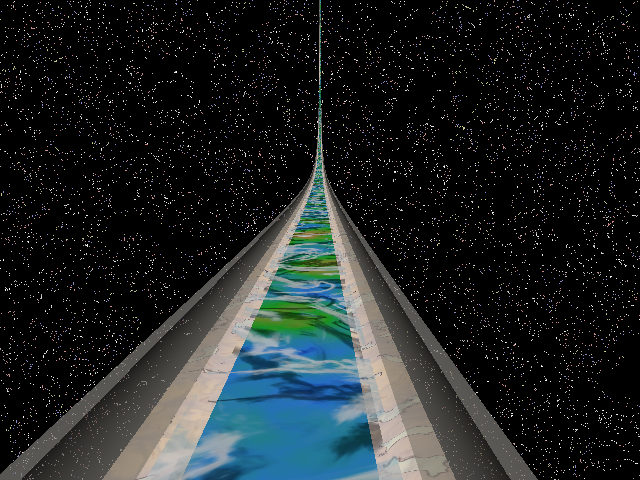
This is going to be a scale model and I’ve chosen a scale of 1 POV-Ray unit being 1,000 km. Here is a crude rendering of our first orbital.
Our basic dimensions are a diameter of 3 million km (3000 POV-Ray units), and a width (wall to wall) of 2000 km and walls some 500 km high.
Now I don’t think anyone really wants to live immediately beside, or even anywhere near a 500 km high wall, so rather than have a right angle between “surface” and “wall” I’ve decided to add a quarter circle buffer zone that curves up from the surface to meet the wall. Thus the available surface is around 1,200 km across – giving us an available surface area of about 1.2 billion square km.
I’ve also added some (equally crude) “mountains” at 3 degree intervals around the circumference (hence about 78,000 km apart) to break up the coriolis winds and allow for different, isolated habitats if needed.
What I was particularly interested in was the appearance of “higher” portions of the orbital in the sky at different widths. This is the same size orbital as above, but viewed from lower down in the atmosphere.
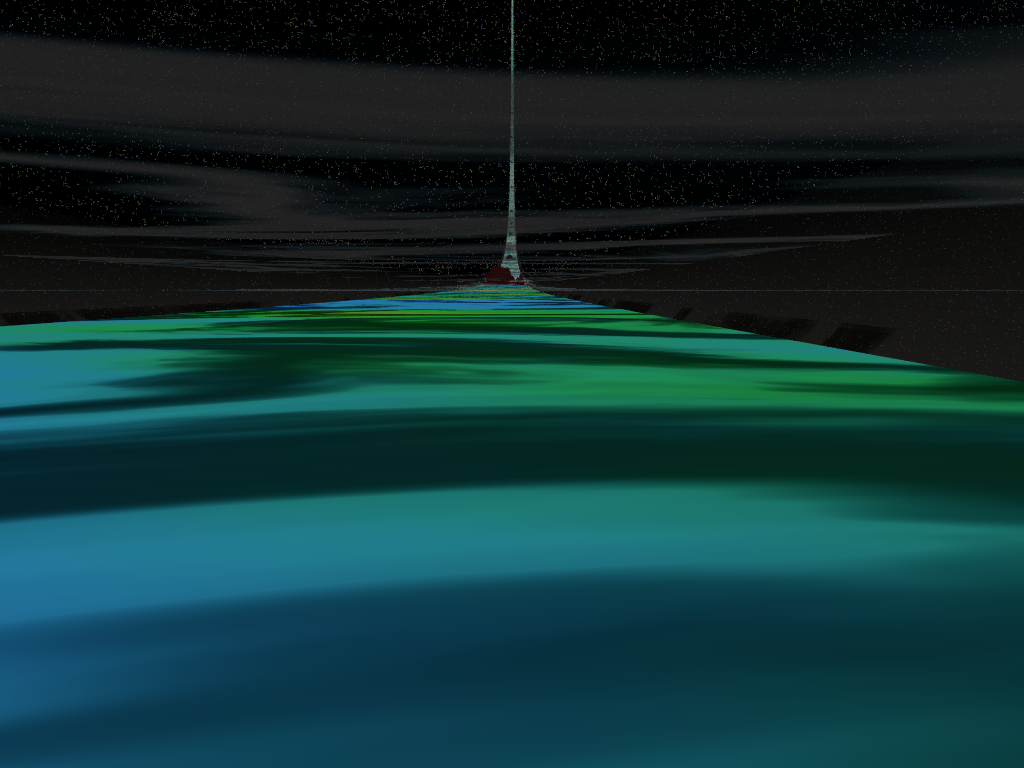
The model doesn’t simulate any atmospheric attenuation but we can assume that the “lower” portions disappear in the haze, leaving the upper ribbon both visible and casting at least as much reflected light as the full moon, if not more, especially if we increase the total width to 10,000km (with around 8,000km of usable land width), as shown below.
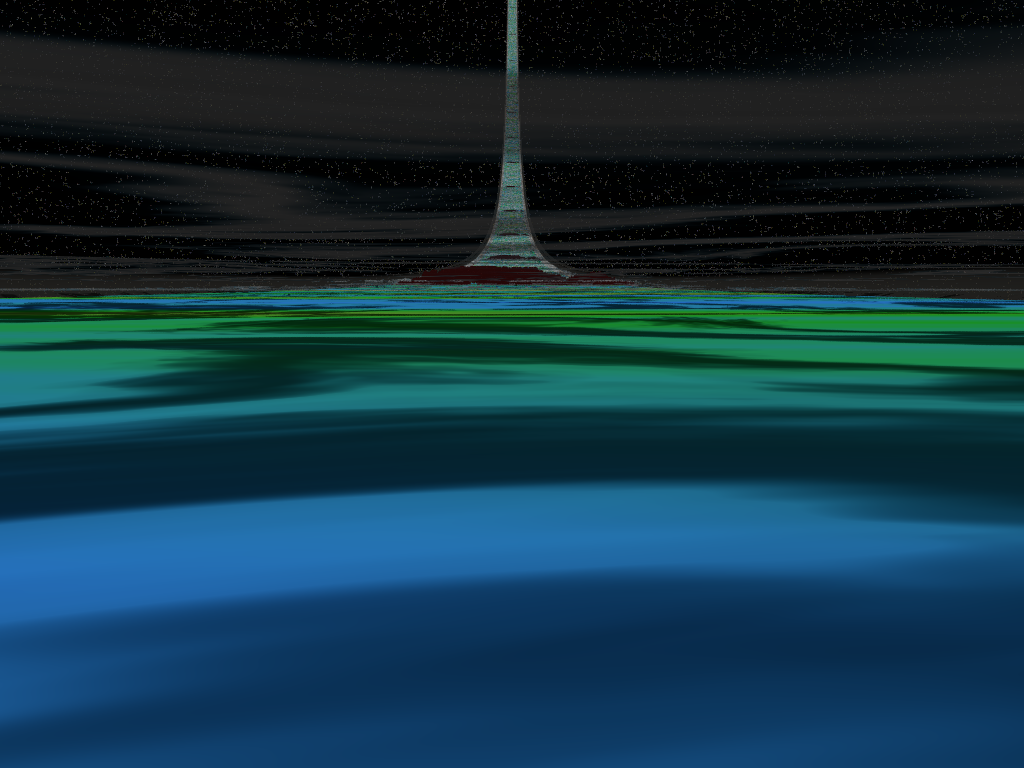
And for any artwork based on orbitals I wanted to know how to realistically show (from the surface) what the rest of the orbital looks like and I think these simulations give me a good idea. Obviously from any point on the surface of the orbital the “arch” can appear in any “compass” direction but will always go straight “up” to meet the other part at a point directly overhead.
I’m also interested in how sunset and sunrise would look on an orbital so the next phase in the simulation is to animate the rotation of our model while looking towards the sun. With this space (or, more accurately, watch this sky!).
If you want to fiddle about with the various settings yourself the POV-ray source file is attached below.